Why Solar Racking Quality Matters in Northern Michigan
When people shop for solar, they ask about panels, inverters, batteries, and payback timelines—racking rarely comes up. That is a mistake. Racking is the most structurally critical part of an array, holding hundreds of pounds of glass and aluminum in place through 25 years of harsh Michigan weather. Yet almost nobody thinks to compare options.
Panels generate electricity and inverters convert it, but quality racking keeps the entire system safe and functional. It must hold everything securely despite heavy winds, deep snow, freeze-thaw cycles, and summer heat swings year after year. Having installed arrays on roofs, pole barns, open fields, and off-grid cabins across Northern Michigan and the Upper Peninsula, we have found four main factors that separate solid racking from systems that fail over time: weather durability, longevity, structural safety, and total energy production.
Weather Resistance
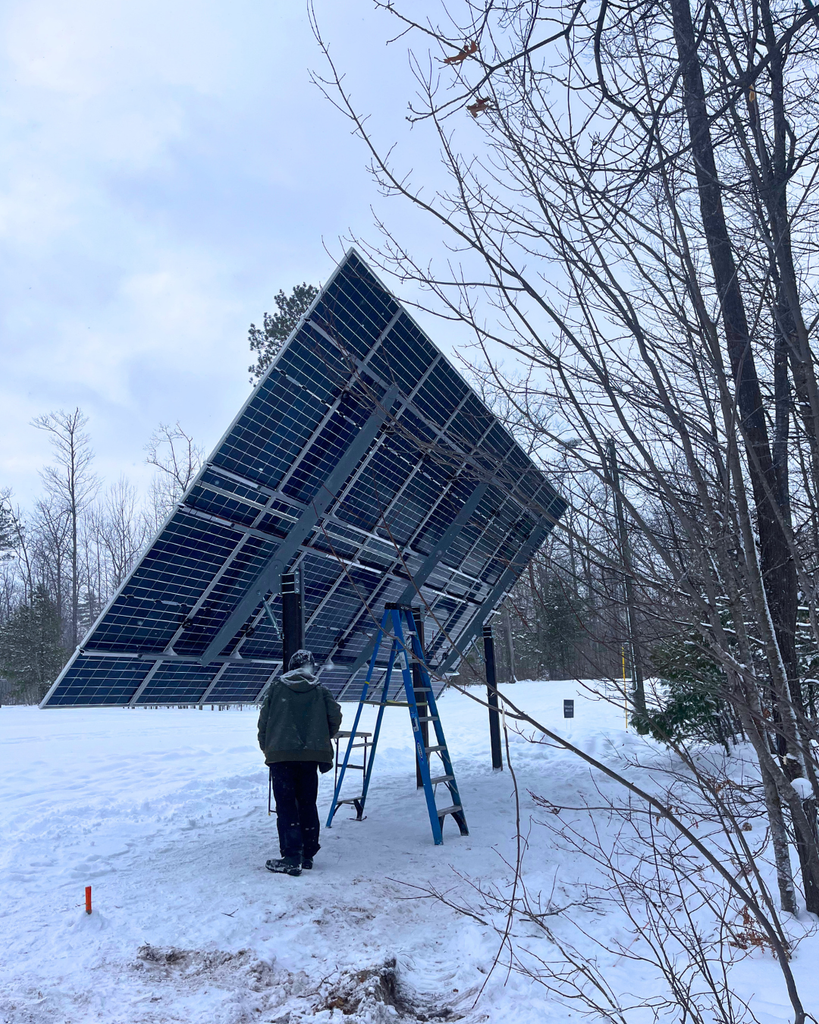
Every racking system has a published snow and wind load rating, but sales conversations almost always skip past them.
In Northern Michigan, lake-effect snow piles up for months. That heavy, wet snow sits on the array while freeze-thaw cycles stress every bolted joint. Add in high winds off the Great Lakes, and the load on the racking is substantial.
Much of the racking on the market is engineered for milder climates. A system might pass initial inspection, but after a few harsh winters, cheap hardware sags, clamps loosen, or ground posts heave out of alignment. That is why we use racking rated for at least 80 psf of snow load as a baseline for local installations.
Durability and Lifespan
Panels carry 25-year warranties, but those guarantees cover the modules, not the frame holding them up. A system’s lifespan ultimately depends on materials and construction.
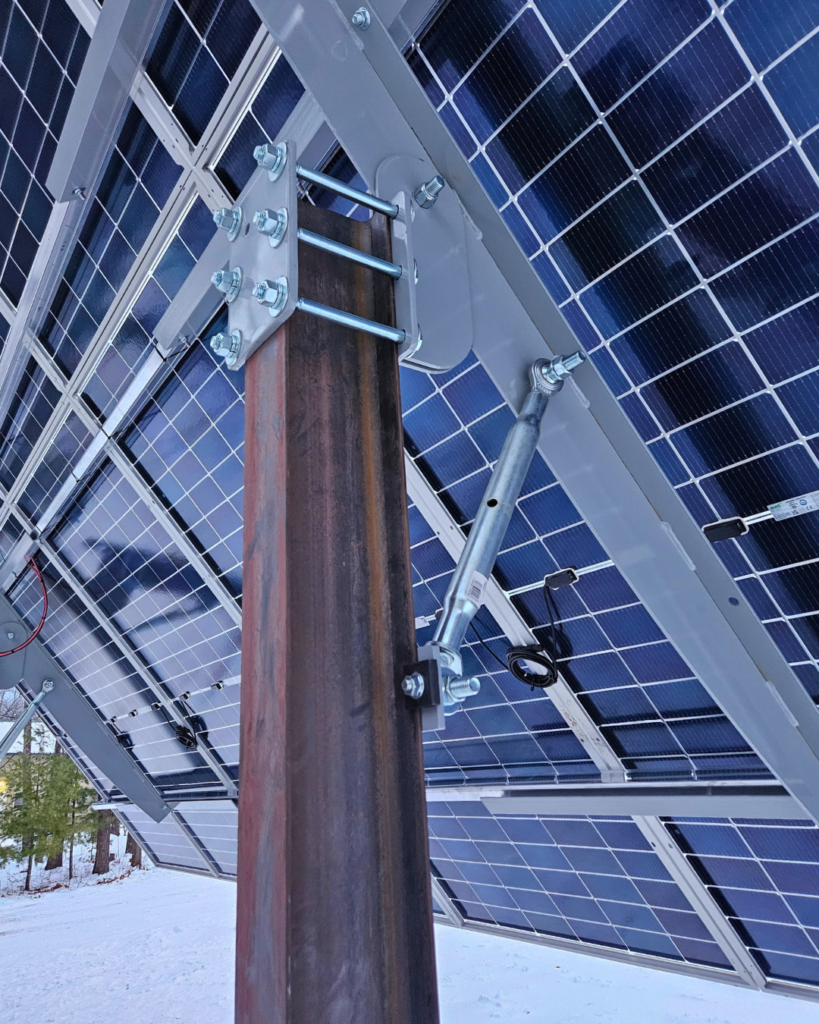
Aluminum provides reliable corrosion resistance, while properly treated steel delivers the structural strength required for heavy snow loads. While bolted joints remain standard, welded connections hold up far better against decades of freeze-thaw cycles without loosening.
Parts availability is another common issue. Racking built with proprietary components can leave owners stranded if a supplier discontinues a line. Using standard structural steel ensures components can easily be repaired or replaced decades down the road.
Safety
Solar arrays carry substantial structural loads. Hundreds of pounds of panels face severe wind uplift and heavy downward snow pressure simultaneously. Racking failure isn’t minor—it can mean an entire row coming down, foundations pulling free, or structural movement damaging high-voltage wiring.
Stamped, site-specific engineering plans are essential. They ensure a structural engineer verified the racking against local wind and snow conditions rather than relying on standard spec sheets. Foundation design is equally critical; driven piles, ballasted blocks, and concrete footings perform differently based on soil type, making selection a deliberate, site-specific choice.
Efficiency
Racking doesn’t generate power, but it dictates how much energy your panels produce. Tilt angle, row spacing, and ground clearance directly affect performance, regardless of panel specs.
Bifacial panels highlight this clearly. These modules generate extra power by capturing sunlight reflected onto their backside, but only if the racking permits enough light underneath. A two-high panel layout with adequate ground clearance allows snow to slide off freely while keeping reflected light unobstructed. Poorly designed racking chokes off this extra yield, causing the system to underperform for 25 years without any obvious sign of damage.
How We Approach This
Having worked in Northern Michigan for years, we know which racking systems hold up to our winters and which fall short. Weather resistance, structural strength, and efficiency are our baseline—not an add-on. When existing market options fell short of these requirements, we engineered our own solution: Tundra Solar Racking.
We bring this same approach to every stage of a project. Engineering, electrical design, foundation work, mounting, and commissioning are all handled in-house. We select components based on what each specific site requires, not what is cheapest to install.
Frequently Asked Questions
What snow load should solar racking be rated for in Northern Michigan? At least 80 psf, whether it’s going on a home, a farm, a business, or an off-grid property. Racking rated for lighter, warmer-climate loads is a common source of structural problems down the road.
How long should solar racking last? It should match or outlast a panel’s 25-year warranty. Corrosion-resistant materials, welded connections instead of bolted ones, and standard structural steel over proprietary parts are what keep a system lasting.
Is racking safety actually something to ask about? Yes. It carries real loads—wind uplift, snow, and the weight of the array itself. Ask whether the system comes with a stamped, engineered plan set specific to your site, not a generic spec sheet.
Does racking really affect how much power an array produces? Yes, more than people expect. Tilt, spacing, and clearance all affect output, and bifacial panels lose a real chunk of their advantage if the racking doesn’t give them room to use it.
The Bottom Line
Racking earns its keep by being boring—when done right, you never have to think about it. If you’re planning a solar array in Northern Michigan or the UP, ask one key question before anything else: what’s holding the system up, and was it built for our winters?
If you’re considering solar for your property, contact us. We’ll walk you through options tailored to your site and ensure your system is built to last.