Commercial Demand Charges: What They Are and How Battery Storage Can Lower Yours
Most commercial businesses focus on one number on their electric bill: total kilowatt-hours used. But for many Michigan businesses, the bigger cost driver isn’t how much power they use; it’s how fast they pull it.
That’s the demand charge, and if you’ve never looked for it on your bill, it may be costing you more than you realize.
What Is a Demand Charge?
Your utility doesn’t just measure how much electricity your building consumes over a month. It also measures the rate at which you consume it. That’s your peak demand. It’s typically recorded as the highest 15-minute average of electricity use during the billing period.
That single 15-minute window sets your demand charge for the entire month.
Here’s why that matters: if your facility runs a piece of heavy equipment for 15 minutes in the middle of an otherwise average day, your demand charge for that month is based on that spike, not the rest of your normal operations.
According to the National Renewable Energy Laboratory (NREL), demand charges can account for anywhere from 30% to 70% of a commercial electricity bill. For manufacturers, cold storage facilities, auto shops, and businesses with significant equipment loads, that’s not a rounding error. It’s a major operating expense.
Peak Shaving: How Battery Storage Addresses the Problem
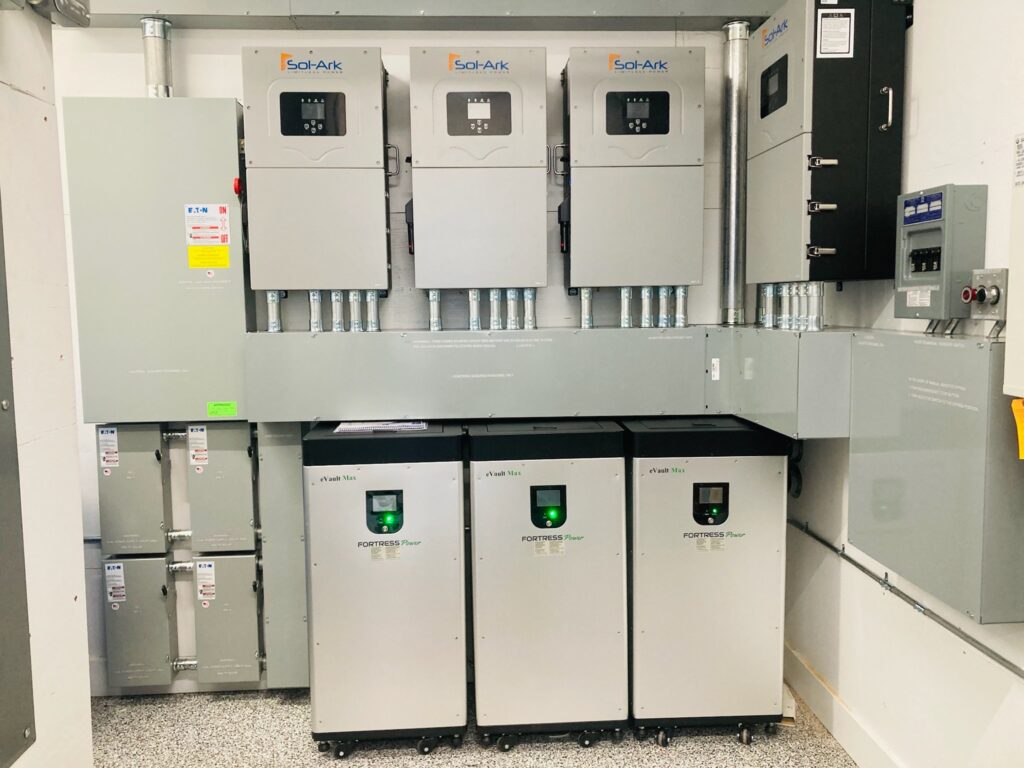
Battery energy storage systems are well known for backup power. But one of their most financially valuable applications in commercial settings is demand management, specifically peak shaving.
Here’s how it works:
- The battery monitors your facility’s energy draw in real time. Modern battery management software tracks consumption and anticipates when demand is approaching a spike.
- When a peak is detected, the battery discharges. Instead of your building pulling that surge from the grid and triggering a higher demand charge, the battery supplies the power.
- The result is a flattened demand curve. Your peak usage looks lower to the utility, which means a lower demand charge on next month’s bill.
This process is called peak shaving, and it works regardless of whether your facility has solar panels. Batteries can charge directly from the grid during off-peak hours and discharge during high-demand periods, no solar required. However, pairing the two systems can increase the financial benefit significantly.
Who Benefits the Most?
Not every business will see the same return from a battery storage system. The strongest candidates tend to be facilities with:
- Large or variable equipment loads — manufacturing equipment, commercial HVAC, refrigerators, welding, pumping systems.
- Predictable daily peaks — operations that consistently draw high power at the same time of day.
- A demand charge that’s a meaningful share of the bill — whether storage pencils out depends on your current demand charge rate and your facility’s load profile; there’s no universal number, which is why a site assessment matters.
- Existing or planned solar — pairing battery storage with a solar array typically produces the strongest financial case.
Agricultural operations, commercial builders, light manufacturing, food processing, and any facility with significant electrical infrastructure are worth a closer look.
The Bottom Line
Demand charges are designed to recover the utility’s cost of maintaining the capacity to serve your facility at its highest draw, even if that peak only lasts 15 minutes a month. Once you understand the mechanism, it becomes clear why battery storage is one of the most effective tools available to manage commercial energy costs.
This isn’t backup power for the sake of convenience. It’s a strategic energy asset that directly reduces what you pay month after month.
If you’re a commercial or industrial operation in Northern Michigan and you’re not sure whether demand charges are a significant part of your bill, start by pulling your last 12 months of statements and looking for a line labeled “demand” or “peak demand.” The number there tells you whether storage is worth a conversation.
Peninsula Solar installs battery storage systems for commercial, agricultural, and industrial customers across Northern Michigan and the Upper Peninsula. If you’d like to understand what a storage system could do for your facility’s energy costs, contact our team to schedule a site assessment.
Own Your Energy☀️